

Walking may seem effortless, but it is actually one of the most complex movements your body performs. Every step involves a finely tuned sequence of muscle activations, joint movements, and balance adjustments. As physical therapists, we analyze these gait patterns. Understanding your gait pattern allows us to understand how your body moves, identify inefficiencies, and correct deviations that can lead to pain or injury.
Before we dive into the most common gait deviations, we will take a closer look at the phases of the gait cycle and how each contributes to healthy walking.
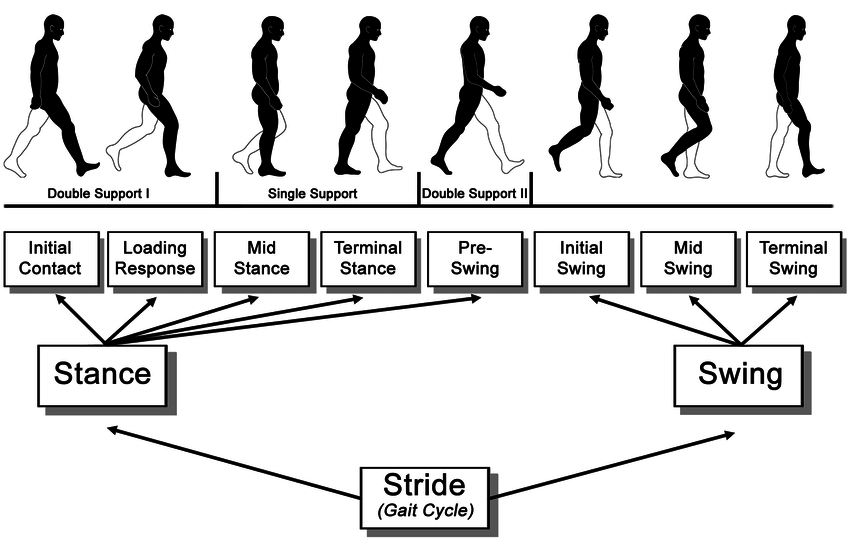
Phases of the Gait Cycle
The gait cycle begins the moment one foot contacts the ground and ends when that same foot touches down again. It is divided into two main phases called the stance phase and swing phase.
1. Stance Phase (about 60% of the gait cycle)
This is when your foot is in contact with the ground, supporting your body weight.
- Initial Contact: The heel strikes the ground, beginning the stance phase.
- Loading Response: The body absorbs impact as weight transfers onto the leg.
- Midstance: The body moves directly over the supporting foot.
- Terminal Stance: The heel lifts as your body weight shifts forward.
- Pre-Swing: The toes push off to propel you into the next step.
2. Swing Phase (about 40% of the gait cycle)
This is when your foot is off the ground, moving forward to prepare for the next step.
- Initial Swing: The foot lifts off and the knee bends to clear the ground.
- Midswing: The leg swings forward underneath the body.
- Terminal Swing: The leg extends to prepare for heel strike.
Each of these phases requires proper timing, strength, flexibility, and coordination. When one part of the system breaks down from pain, weakness, or limited mobility, gait deviations occur.
Common Gait Deviations and What They Mean
1. Antalgic Gait (Limping)
What it looks like: Shortened stance phase on one leg: You spend less time on the painful side.
What it means: This is your body’s protective response to pain from injuries like ankle sprains, knee arthritis, or hip bursitis.
PT focus: We identify the pain source, use manual therapy to restore mobility, and strengthen surrounding muscles to normalize your walking pattern.
2. Trendelenburg Gait
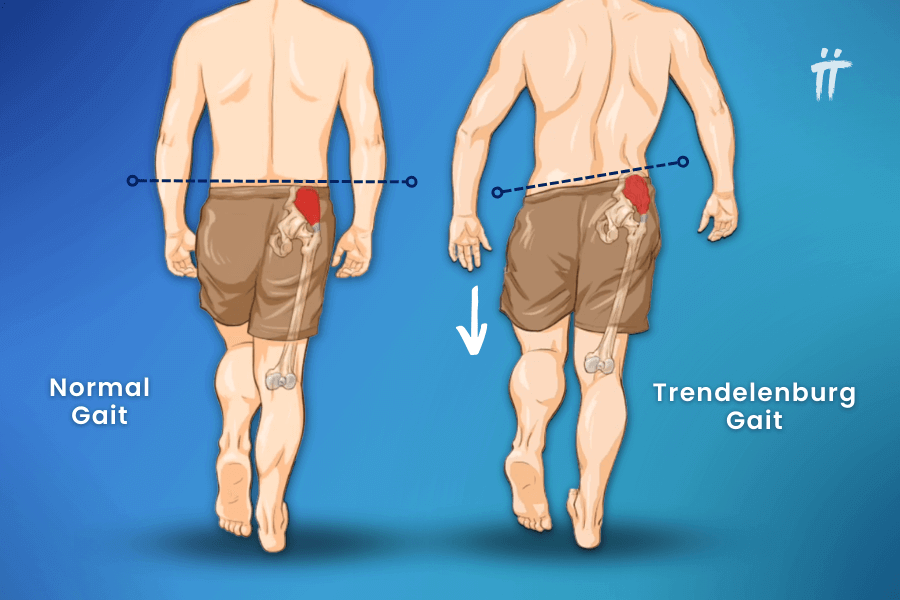
What it looks like: The pelvis drops on the opposite side of the stance leg, creating a “hip drop.”
What it means: Weakness in the gluteus medius (hip stabilizer) or nerve injury affecting hip control.
PT focus: Strengthen hip abductors, improve posture and stability, and retrain walking mechanics to reduce back or hip pain.
3. Foot Drop (Steppage Gait)
What it looks like: Lifting the knee higher than normal to prevent the toes from dragging.
What it means: Weakness or nerve injury affecting the muscles that lift the foot. This is common after lumbar nerve compression, stroke, or trauma.
PT focus: Neuromuscular re-education, strengthening, balance training, and in some cases, bracing (AFO) for improved safety.
4. Circumduction Gait
What it looks like: The leg swings out in a circular motion during the swing phase to clear the ground.
What it means: Limited knee flexion, weak hip flexors, or stiff joints often cause this compensatory motion.
PT focus: Improve joint mobility, strengthen hip and knee flexors, and retrain proper swing mechanics.
5. Vaulting Gait
What it looks like: Rising on the toes of one leg to help the other leg clear the floor.
What it means: Often compensation for leg length discrepancy, stiff joints, or difficulty bending the knee or hip.
PT focus: Identify the cause of asymmetry, restore flexibility, and correct movement mechanics.
6. Ataxic Gait
What it looks like: A wide, unsteady, or staggering walking pattern, as if balancing on an uneven surface.
What it means: Usually related to balance or coordination issues caused by neurological conditions.
PT focus: Balance retraining, proprioceptive exercises, and core stability to improve safety and walking confidence.
Why Gait Analysis Matters
Even small deviations can create a chain reaction of stress through your body which can affect your knees, hips, lower back, and even your posture. Through professional gait analysis, a physical therapist can observe your walking pattern across all gait phases, identify where dysfunction occurs, and develop a customized plan to correct it.
Whether your issue stems from injury, weakness, or posture, improving your gait can lead to:
- Reduced pain and fatigue
- Improved balance and coordination
- Better joint alignment
- Enhanced performance in daily activities or sports
If you have noticed limping, uneven steps, or pain when walking, Respire’s physical therapists can help you get back to moving efficiently and confidently again. Call Respire Physical Therapy at the Falls Church Location (703-671-1871) or the Annandale Location (571-369-6728) to schedule an appointment with one of our skilled Physical Therapists today! Click here to request an appointment online and we will contact you as soon as possible.

Tags: fallschurchva, movement is medicine, annandaleva, evidence based practice, Physical Therapy, painfreeliving, gait analysis, Respire Physical Therapy, washingtondc, health blog, physical therapist, gait training, hip drop, trendlenburg gait, balance training, arlingtonva, pt education, alexandriava, regain your movement freedom